The Accelerated Life
Living Fully When Time No Longer Feels Assumed
A book, speaking message, and emerging community for people living with Parkinson’s, chronic illness, caregiving, aging, and the sacred urgency of finite time.
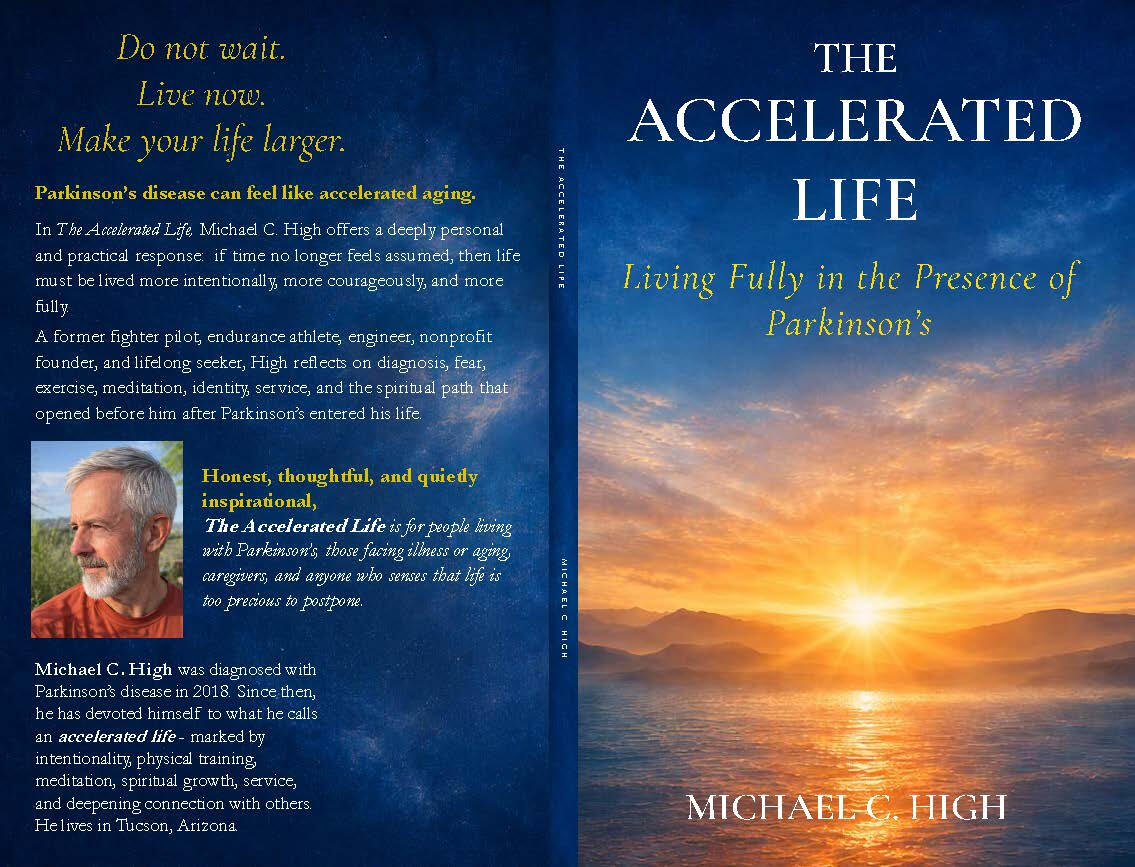
About the Book
The Accelerated Life: Living Fully in the Presence of Parkinson’s is a personal, practical, and reflective book about what becomes possible when life no longer feels open-ended.Parkinson’s changed Mike High’s relationship with time. It made life feel more fragile, more urgent, and more precious. This book is not about pretending everything is fine. It is about choosing to live more fully inside uncertainty, limitation, love, purpose, and possibility.
Now available in paperback and Kindle on Amazon.
The Core Message
The Accelerated Life begins with Parkinson’s, but it is not only for people with Parkinson’s.It is for anyone who has begun to understand that time is not theoretical.It is for people living with illness, caring for someone they love, navigating aging, facing uncertainty, or feeling called to stop postponing the life that matters.
Reflections & Resources
Evidence-informed summaries, personal reflections, and field notes on Parkinson’s, mindfulness, caregiving, adventure, and living fully now.
Meditation, Mindfulness, and Parkinson’s
A plain-English summary of Mike’s World Parkinson Congress poster, including the research reviewed, key takeaways, limitations, a gentle starting practice, and the full poster download.
One Step at a Time
Climbing Kilimanjaro with Parkinson’s
A lifelong goal became a ten-day journey through preparation, uncertainty, shared effort, thin air, and unexpected possibility. Mike reflects on climbing to the highest point in Africa—and what the mountain taught him about help, control, and living before the time feels perfect.
Go With the Flow
Egypt, Parkinson’s, Time, Wonder, and the Red Sea
In 2003, Mike flew over Egypt in an F-16 and saw the Nile cutting a green line through the desert. More than twenty years later, he returned on the ground—into Cairo, the pyramids, the Sahara, Luxor, the Red Sea, and an unexpected meditation broadcast back to Tucson.
Guided Meditation
A 15-minute practice for breath, presence, and steadiness
Begin with a simple guided meditation created for people living with Parkinson’s, care partners, and anyone learning to pause, breathe, and return to the present moment.
Join The Accelerated Life Community
The book is the door. The community is the house.Join the list for occasional reflections, practical resources, new essays, speaking and gathering updates, and early invitations as The Accelerated Life community develops.Thoughtful communication, not constant email.
Invite Mike to Speak
Mike High speaks with warmth, humor, honesty, and hard-earned clarity about Parkinson’s, purpose, family, resilience, spirituality, caregiving, and the invitation to live deeply when time no longer feels assumed.Possible speaking topics include:• The Accelerated Life: Living Fully When Time No Longer Feels Assumed
• Parkinson’s, Presence, and Purpose
• The Sacred Urgency of Finite Time
• Living Intentionally with Chronic Illness
• For Caregivers: Love, Limits, and the Long Road TogetherMike’s talks can be adapted for Parkinson’s and caregiver groups, healthcare and wellness organizations, corporate retreats and leadership offsites, employee resilience programs, civic groups, and spiritual communities.
Future Retreats and Excursions
In time, The Accelerated Life will offer small-group retreats and meaningful excursions built around presence, movement, nature, reflection, conversation, beauty, and intentional living.These gatherings will not be about escaping life. They will be about entering it more fully.
About Mike
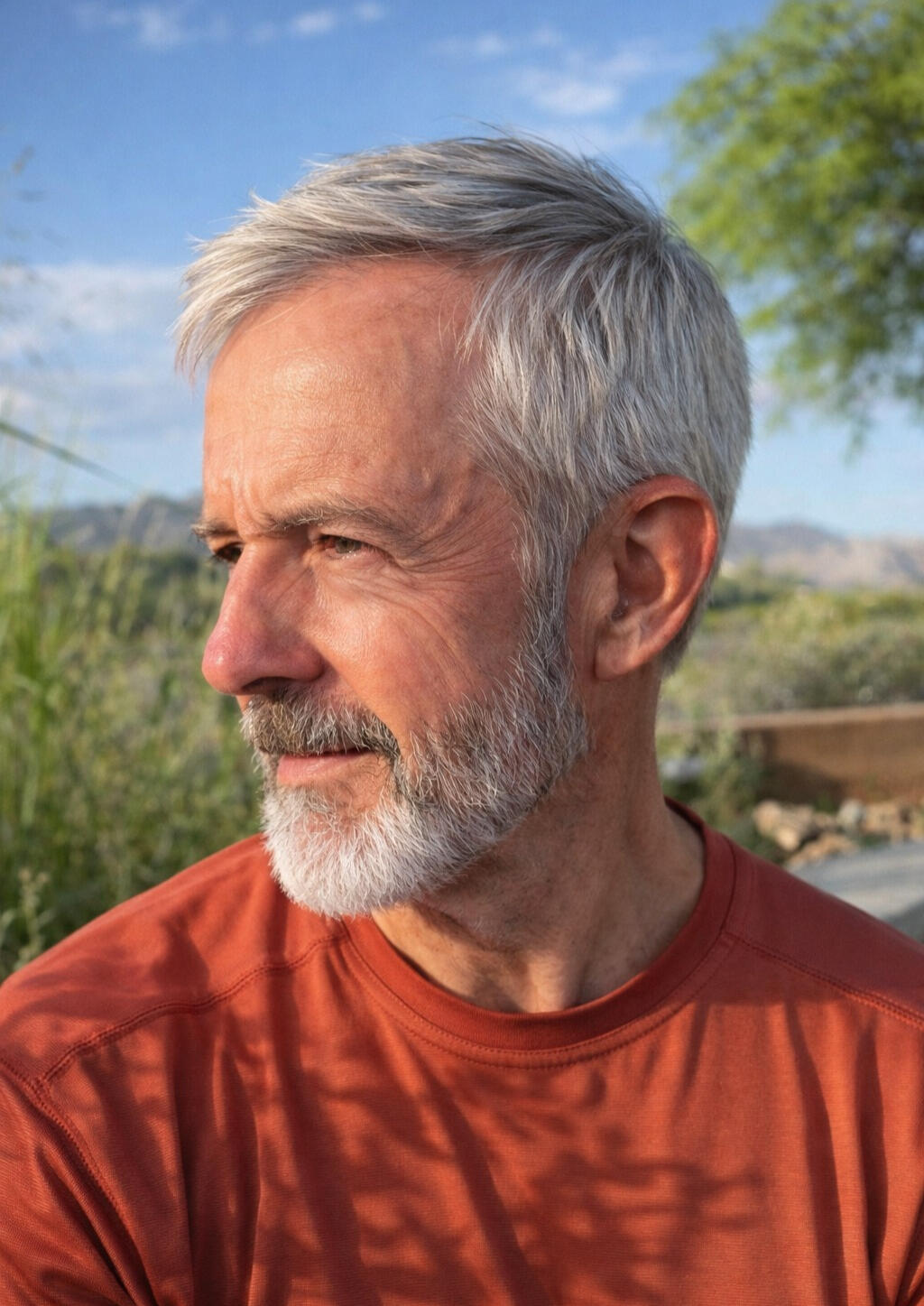
Mike High is the author of The Accelerated Life: Living Fully in the Presence of Parkinson’s. A former Air Force fighter pilot, engineer, business leader, nonprofit founder, husband, father, and person living with Parkinson’s, Mike writes and speaks about purpose, presence, resilience, love, spirituality, and the decision to live fully in the life that is actually here.
The Accelerated Life
Meditation, Mindfulness, and Parkinson’s
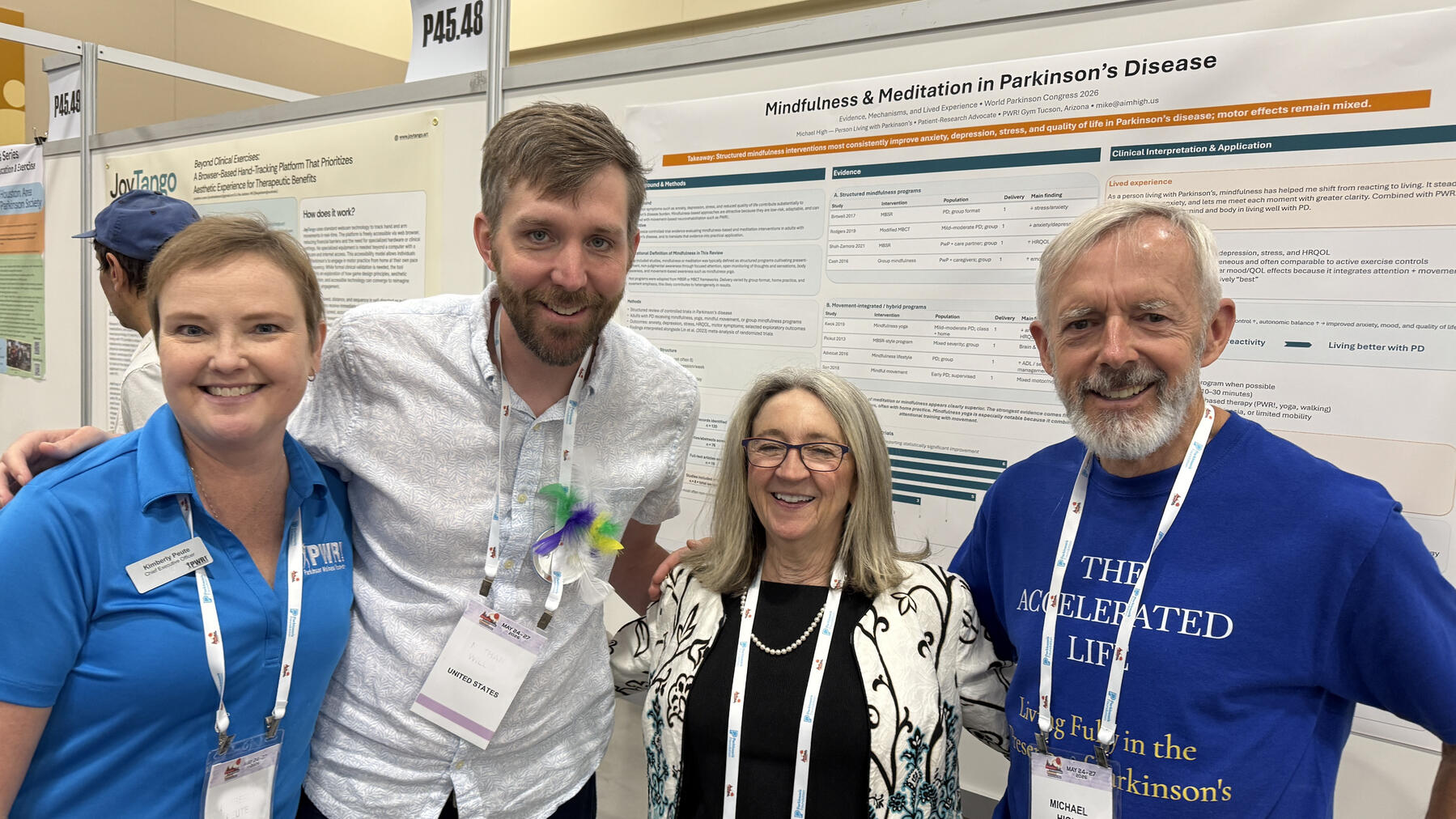
Mike High presenting his poster on meditation, mindfulness, and Parkinson’s at the World Parkinson Congress.
A WPC Poster Summary
At the World Parkinson Congress, I presented a poster exploring meditation and mindfulness practices in relation to Parkinson’s disease. This page offers a plain-English summary of the poster, along with key takeaways, limitations, a gentle starting practice, and links to additional resources.The topic matters to me personally. As someone living with Parkinson’s, I am interested not only in how we treat symptoms, but in how we live with greater presence, steadiness, meaning, and intention.
Plain-English Summary
Parkinson’s disease affects movement, but it also affects much more than movement. Many people with Parkinson’s experience stress, anxiety, sleep disruption, mood changes, fatigue, changes in attention, and the emotional weight of living with a progressive condition. Care partners often carry their own version of that burden.Meditation and mindfulness practices do not cure Parkinson’s, and they should not be viewed as substitutes for medical care, movement, medication, physical therapy, or other evidence-based supports. But they may offer something important: a practical way to relate differently to stress, uncertainty, discomfort, and change.The research reviewed in this poster suggests that meditation and mindfulness-based practices may support quality of life, emotional regulation, stress reduction, attention, self-awareness, and coping for some people with Parkinson’s. Practices studied across the literature vary widely and may include mindfulness meditation, breath awareness, body awareness, compassion practices, yoga-related mindfulness, and structured programs such as mindfulness-based stress reduction.The evidence is promising but not definitive. Many studies are small, use different methods, and vary in how they define the practice, measure outcomes, and follow participants over time. More research is needed, especially larger studies with clearer protocols, better long-term follow-up, and more consistent reporting of disease stage, practice frequency, and participant experience.The practical takeaway is modest but meaningful: meditation and mindfulness may be useful as part of a broader approach to living with Parkinson’s. For some people, these practices may help create a little more space between stimulus and reaction, between symptom and identity, between fear and the next faithful step.
Key Takeaways
Meditation and mindfulness practices may help some people with Parkinson’s manage stress, emotional regulation, attention, and quality of life.
The strongest evidence is not that meditation “treats Parkinson’s,” but that it may support how people live with Parkinson’s.
Practices vary widely across studies, including mindfulness meditation, breathing practices, body awareness, compassion practices, and structured mindfulness-based programs.
More research is needed, especially with larger studies, clearer protocols, better long-term follow-up, and better reporting of disease stage, practice dose, and participant experience.
For many people, meditation may be most useful as part of a broader life practice that includes movement, social connection, medical care, purposeful activity, and intentional living.
Why This Matters for The Accelerated Life
The Accelerated Life is about living fully when time no longer feels assumed.Meditation and mindfulness are not magic cures, and they are not replacements for medical care. But they may offer practical ways to meet uncertainty with more steadiness, awareness, compassion, and intention.For me, this work sits at the intersection of science, lived experience, and the deeper human question: how do we live well in the life that is actually here?That question is at the heart of The Accelerated Life.
A Gentle Starting Practice
Sit comfortably.Let your attention rest on the breath.Notice one inhale and one exhale.When the mind wanders, return gently.Begin with two or three minutes.The goal is not to stop thinking. The practice is returning.This is not medical advice. People with Parkinson’s should adapt practices to their own needs and consult appropriate professionals when needed.
The Accelerated Life
One Step at a Time
Climbing Kilimanjaro with Parkinson’s—and Learning What Preparation, Help, and Possibility Really Mean
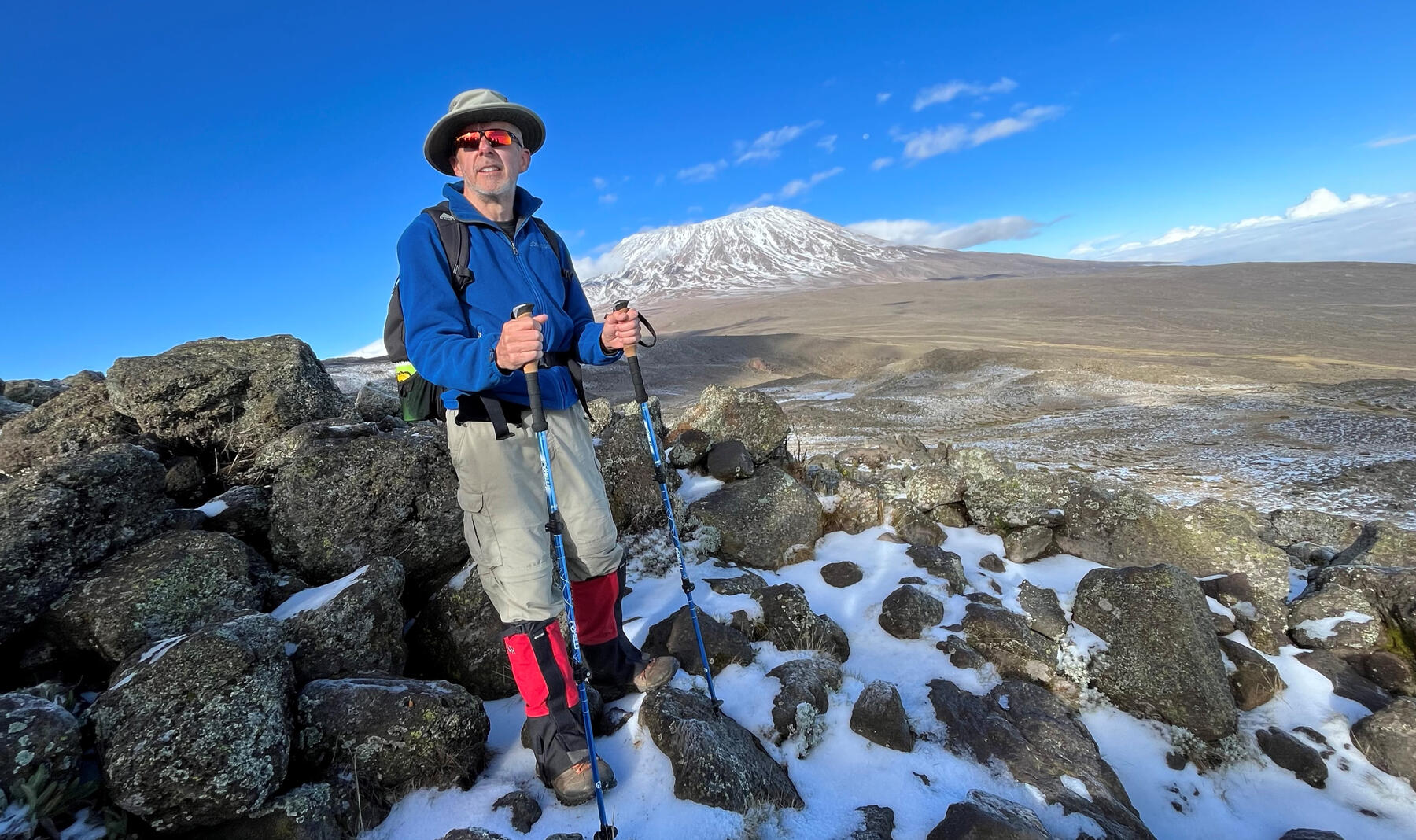
Mike hiking among volcanic rocks with the snow-covered summit of Mount Kilimanjaro behind him.
Kilimanjaro had fascinated me for most of my life.
I have always loved high places. I have always loved hiking up mountains—not technical climbing, but the steady work of putting one foot in front of the other and gradually rising above the world below.
By the spring of 2022, the thought that had lived in the background for decades became much simpler:
I had better do it now, because the time will never be better.
I was living with Parkinson’s disease, but the diagnosis did not determine the decision. I did not begin by asking whether a person with Parkinson’s could climb Kilimanjaro. I began with the understanding that this was something I had always wanted to do—and that postponing it would not make the opportunity better.
Six months later, I was in Tanzania with my daughter Rachel, her friend Paul, six people we had only just met, and an extraordinary team of Tanzanian guides and support personnel.
We were about to begin the Grand Traverse of Mount Kilimanjaro.
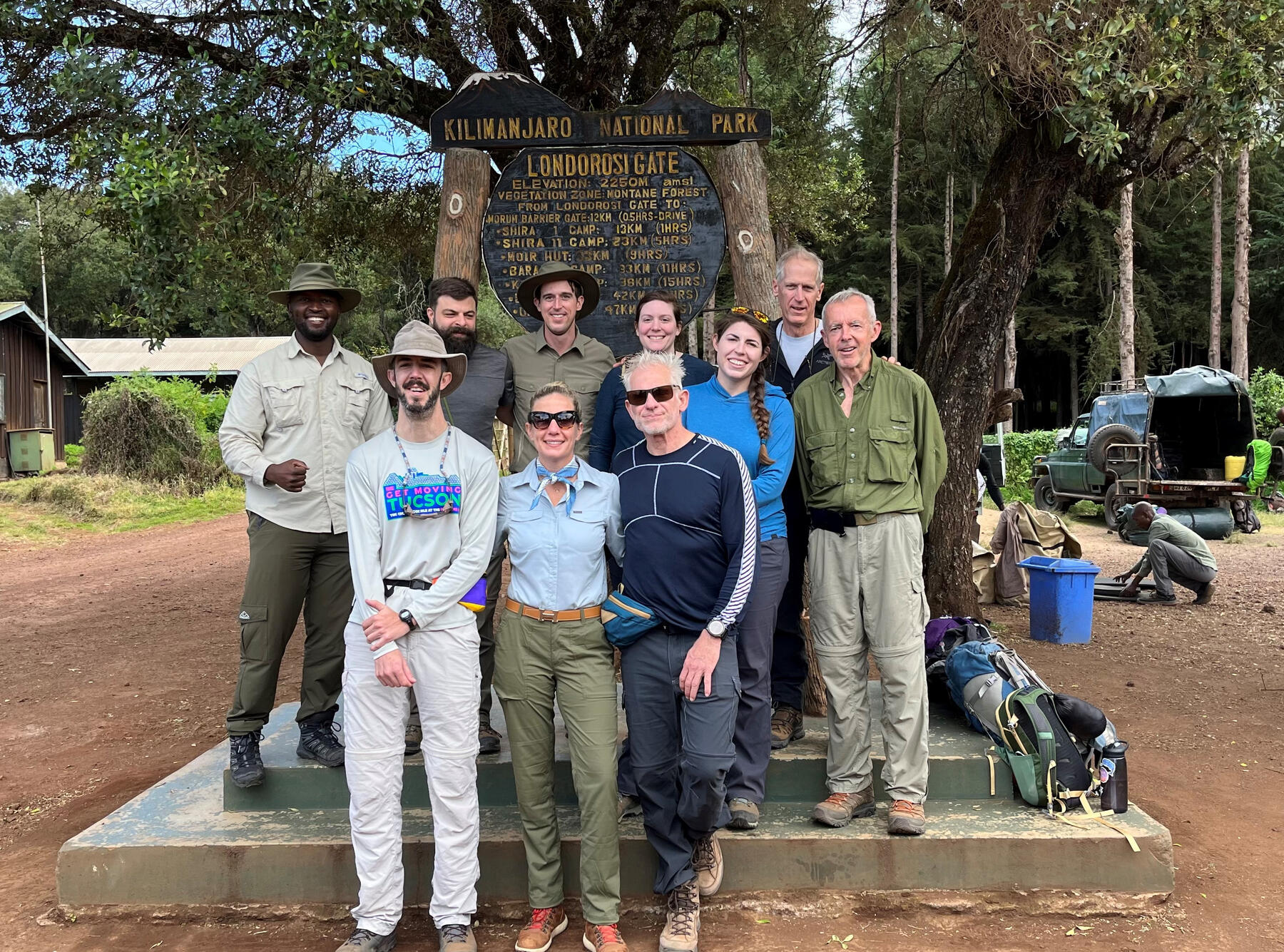
Nine hikers began the Grand Traverse at Londorosi Gate.
A Goal Bigger Than the Diagnosis
Before I left, the mountain represented a major goal and something powerful to anticipate.
It also represented a declaration—to the diagnosis, to the world, and perhaps to myself—that I had not become a different person.
I was still me.
Parkinson’s was part of my life, but I was not willing to grant it authority over every decision I made. The mountain was not an attempt to prove that Parkinson’s did not exist. It was an affirmation that my life, my curiosity, and my appetite for challenge still existed too.
No friend, physician, physical therapist, or trainer told me the climb was unrealistic. The people who knew me and understood my physical condition were pleased for me rather than alarmed.
That confidence mattered. But it also reflected something important: I had been preparing for this kind of challenge for years, even before I knew Kilimanjaro would become the goal.
Preparation Without the Illusion of Control
We committed to the trip in approximately June 2022, leaving only about six months before the expedition.
I did not radically change my life. I was already exercising consistently and had years of hiking and backpacking experience. I added several longer hikes and carried a day pack weighing about twenty pounds. I practiced using trekking poles, particularly because I have always respected the risks of descending steep or uneven terrain.
I reviewed my medications and made sure there were no known conflicts with the medication prescribed to reduce the effects of altitude. I paid attention to sleep, hydration, weather, equipment, and the realities of spending many consecutive days outdoors.
But I did not pretend that preparation gave me control.
In the Air Force, we used to say that no plan survives contact with the enemy. On the mountain, the principle is similar: no plan survives unchanged once the climb begins.
Preparation does not guarantee that events will unfold as expected. It gives you a stronger foundation from which to respond when they do not.
Fitness mattered. Experience mattered. Equipment mattered. The guides mattered. The team mattered.
Control was largely an illusion.
Readiness was not.
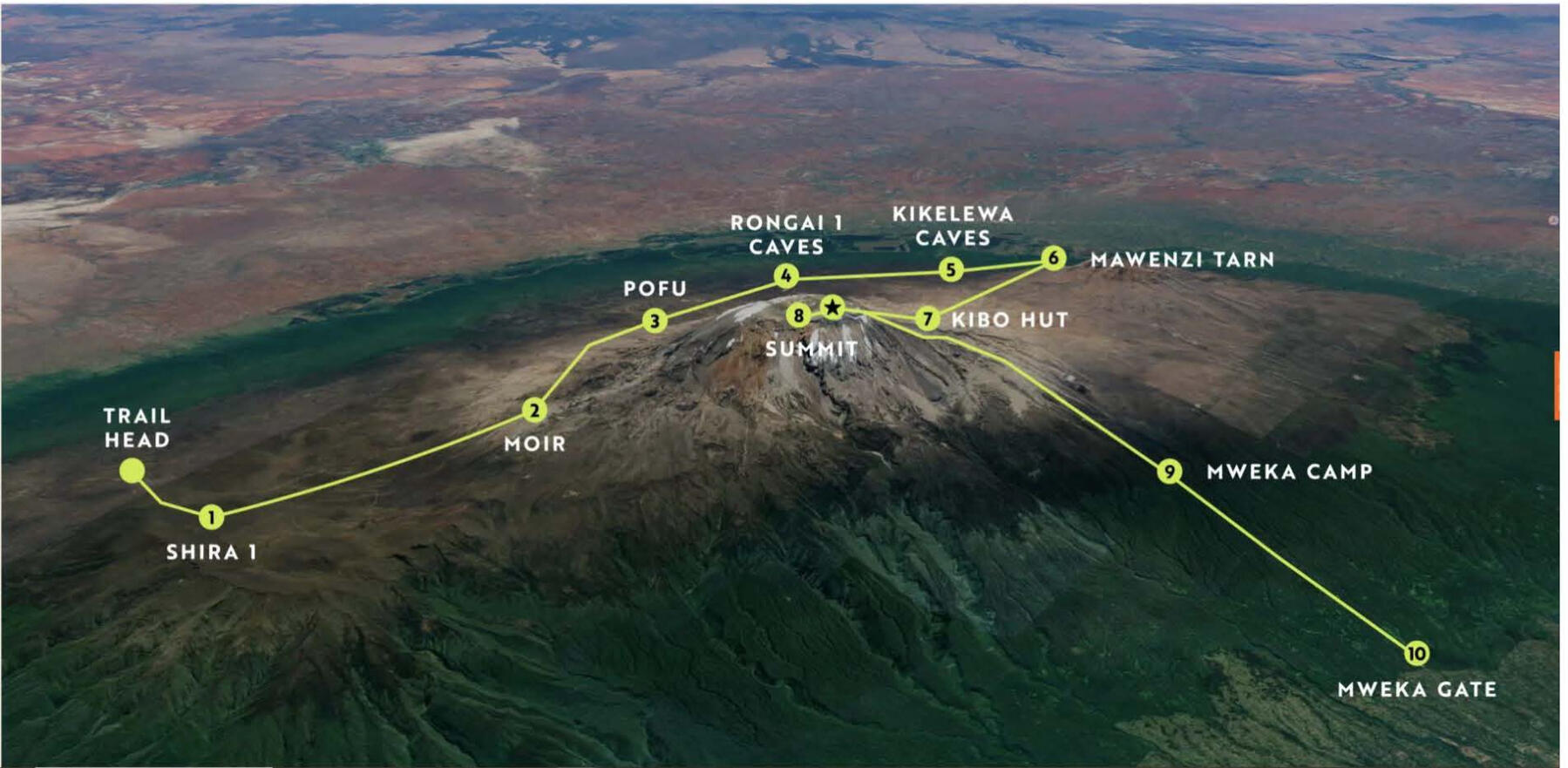
The ten-day Grand Traverse route across Kilimanjaro.
No One Climbs Alone
There were nine hikers in our group. We were supported by four guides and a large team of porters and expedition staff.
I knew only Rachel and Paul when we arrived in Tanzania. The other six hikers became companions almost immediately. The guides and support team became essential to everything we did.
Food appeared at remote camps. Tents were ready when we arrived. Equipment traveled ahead of us. Routes were assessed. Weather, pacing, health, and morale were constantly monitored.
The photographs may show the hikers at the summit, but the achievement belonged to a much larger group.
That lesson became increasingly clear as the terrain grew harder. There were boulder fields to cross, creek beds to descend into and climb out of, and places where an extended hand made the difference between an awkward struggle and a safe step.
I asked for help.
So did everyone else.
The mountain made asking for help feel less like weakness and more like participation in a shared undertaking.
One Step at a Time
The Grand Traverse was a ten-day expedition, with our summit occurring on the eighth day.
For much of the climb, our attention narrowed to the next few feet of trail. We moved through forest, moorland, volcanic rock, mist, cold, and increasingly thin air.
The summit remained the larger goal, sometimes visible in the distance. But the mountain itself was experienced one step at a time.
That is one of the clearest memories I retain: the tension between keeping sight of a great destination and remaining fully attentive to the ground immediately in front of me.
Looking too far ahead could become overwhelming.
Looking only at the next step made the mountain manageable.
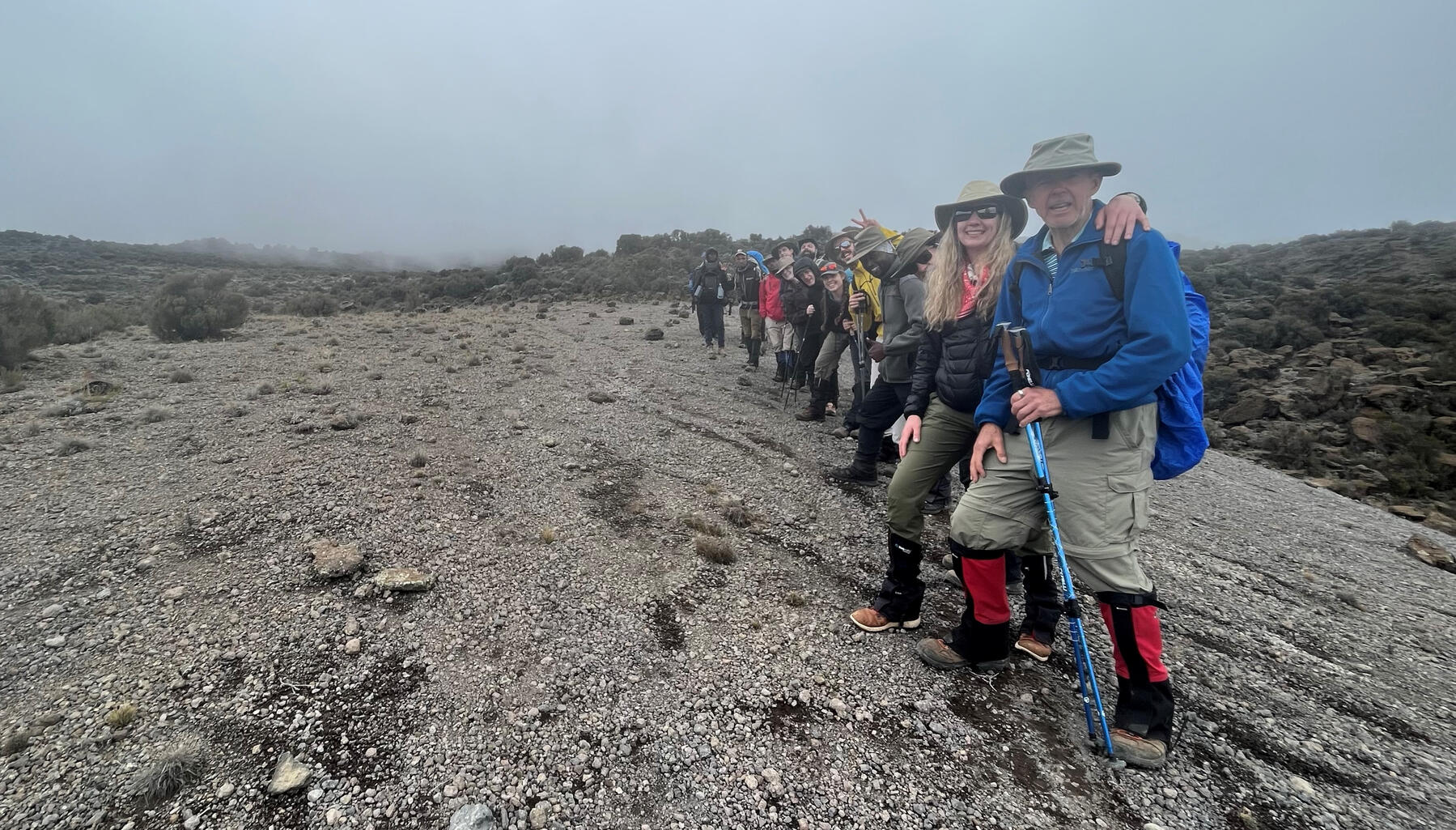
Much of the mountain was experienced one step—and a few feet of trail—at a time.
Summit Morning
We left our camp at approximately 3:00 in the morning.
For about three hours, we climbed in darkness through rocky volcanic terrain, following steep switchbacks by the light of our headlamps.
It was difficult, but there was no moment when I believed we would not make it.
Then the sun began to rise.
Even now, the memory brings back the sensation of that morning—the light growing over the mountain, the cold air, the dark ground becoming visible, and the understanding that a moment imagined for decades was approaching.
We first reached the crater rim. It was not yet Uhuru Peak, but emotionally it felt almost like the summit. Once I reached that point, I knew we had it.
The final stretch required another hour or so along the rim of the volcano. Snow and sleet began to fall. The trail became icy. Despite being January in an equatorial region, the summit environment was unmistakably severe.
And then we reached the sign.
Uhuru Peak.
19,341 feet.
The highest point in Africa.
It is difficult to approach that sign without emotion.
I had wanted this for most of my life. When it became real, the tears came easily.
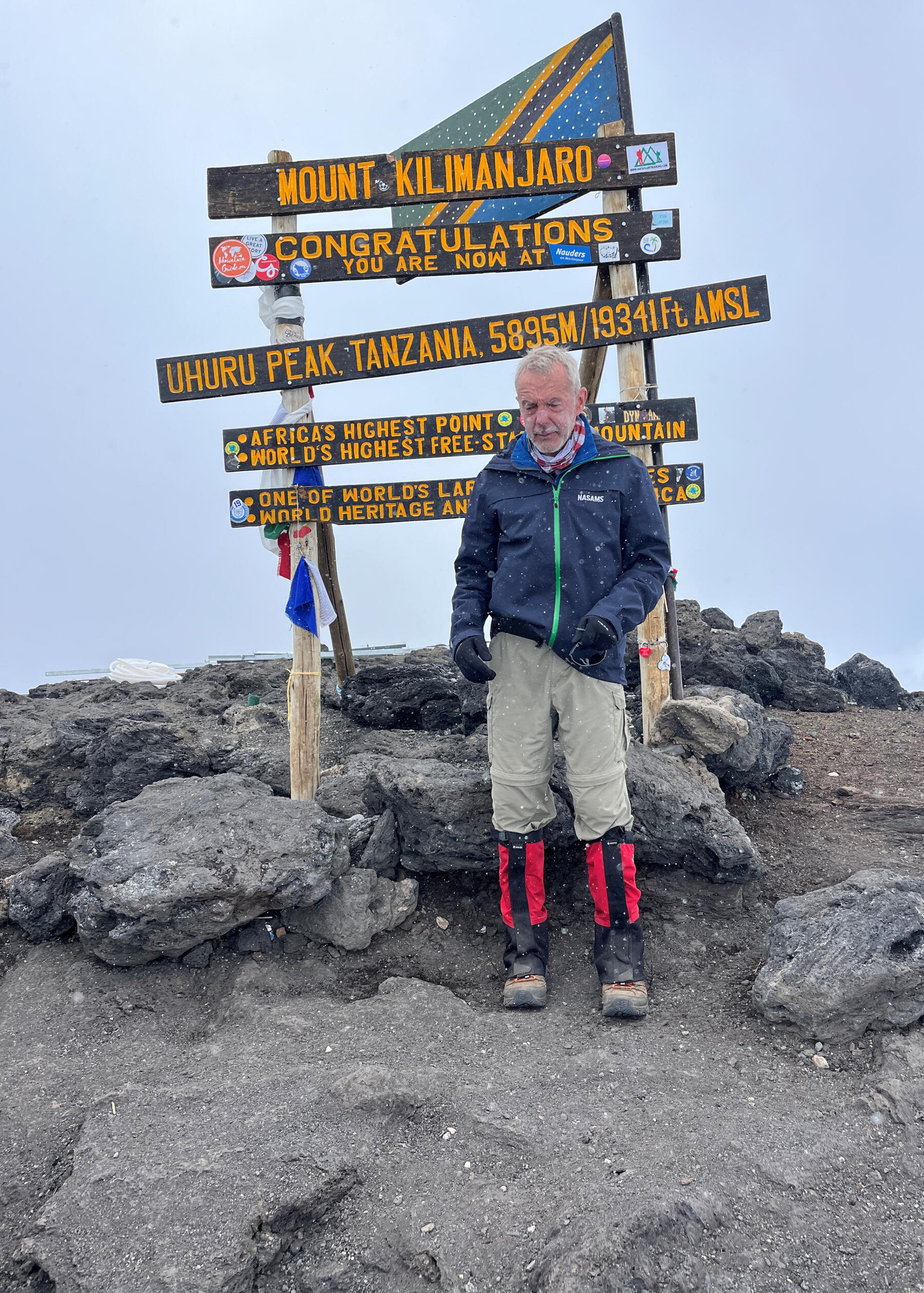
Uhuru Peak, 19,341 feet: the culmination of a lifelong goal.
At the Summit
What surprised me most was how good I felt.
I was not seriously short of breath. I was not overwhelmed by cold or fatigue. I felt strong, present, and deeply grateful.
We remained at the summit for perhaps thirty minutes. I could have stayed longer, but the summit was not the end of the day. We still had many hours of descent ahead before reaching the next camp.
Parkinson’s had remained mostly in the background throughout the expedition. I did not experience the climb primarily as “a person with Parkinson’s climbing Kilimanjaro.” I experienced it as myself climbing a mountain I had long wanted to climb.
Other people saw something additional.
Our new companions told me that they were inspired. The guides sometimes treated me with a little extra deference. They understood the diagnosis as a meaningful part of the accomplishment, even when I had not been thinking about it that way.
That may have been the first time I seriously considered that simply continuing to live my life could become a source of encouragement to others.
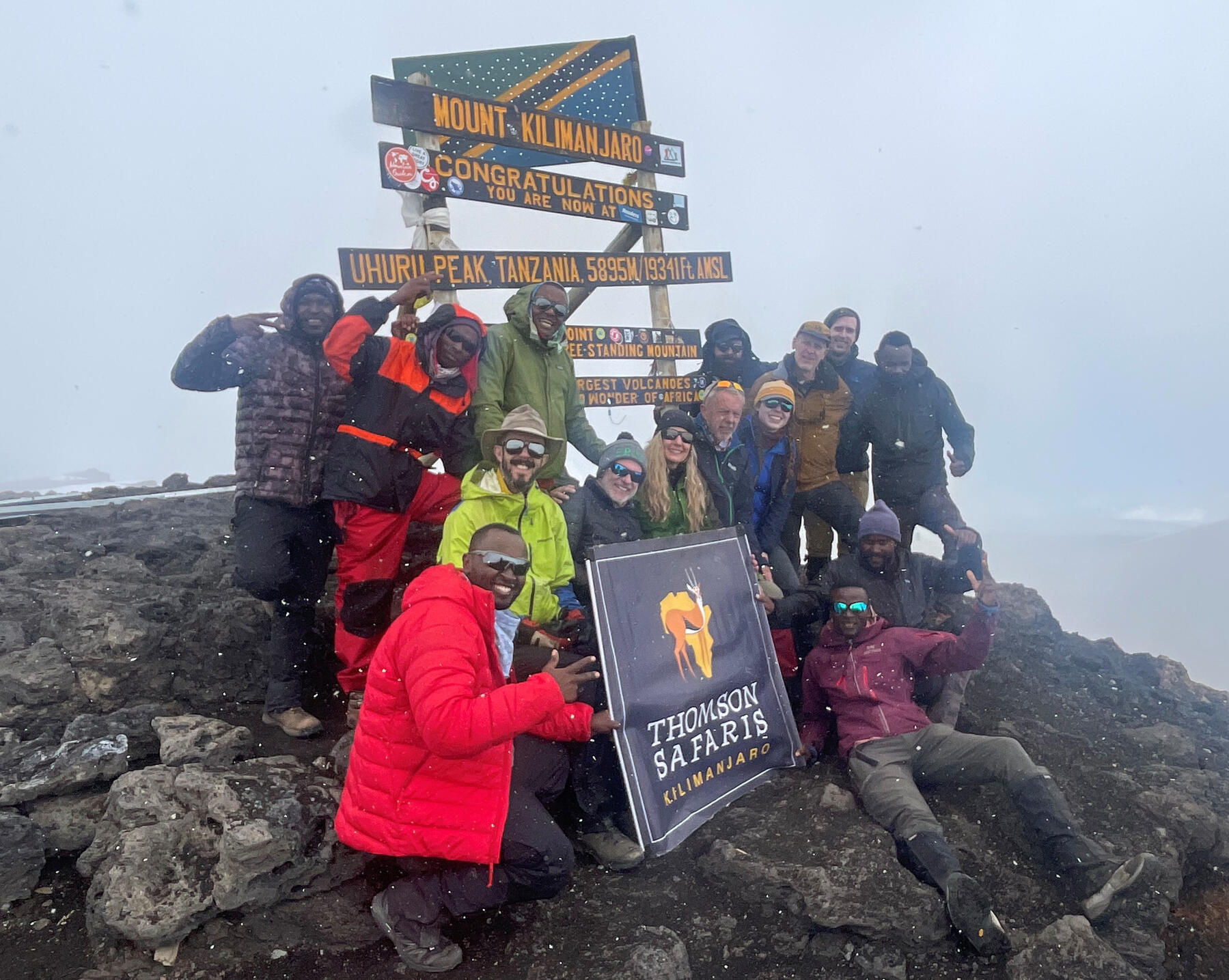
The summit belonged not only to the hikers, but to the guides and support team who made the expedition possible.
The Long Way Down
A summit is dramatic. A descent is practical.
After the photographs, congratulations, embraces, snow, and emotion, we had to start walking again.
The mountain still required attention. There was no magical transport back to comfort. We had to descend through loose rock, changing weather, fatigue, and the accumulated strain of the previous days.
That is another lesson easily forgotten: reaching a goal does not remove the need for patience, judgment, and continued effort.
The summit was a moment.
The expedition was the whole journey.
When the View Opened
After leaving Kilimanjaro, we spent one night in Arusha. The following day, we flew from the smaller Arusha airport west toward the Serengeti.
I did not want to leave the mountain and immediately enter a crowded international airport for a journey of more than twenty hours home.
The Serengeti gave us time to decompress, absorb what had happened, and move from effort into wonder.
On Kilimanjaro, we had often watched the ground five or eight feet in front of us.
On the Serengeti, the view opened across enormous plains.
Instead of concentrating on the next step, we sat quietly and received what was around us: lions, elephants, giraffes, cheetahs, wildebeest, zebra, and distances that seemed almost without end.
One of the most vivid encounters was watching three lions chase down a zebra. It was beautiful, terrible, natural, and immediate—a powerful reminder of what is often called the circle of life.
The mountain and the Serengeti were not competing experiences. They completed each other.
One demanded effort.
The other invited attention.
Both required presence.
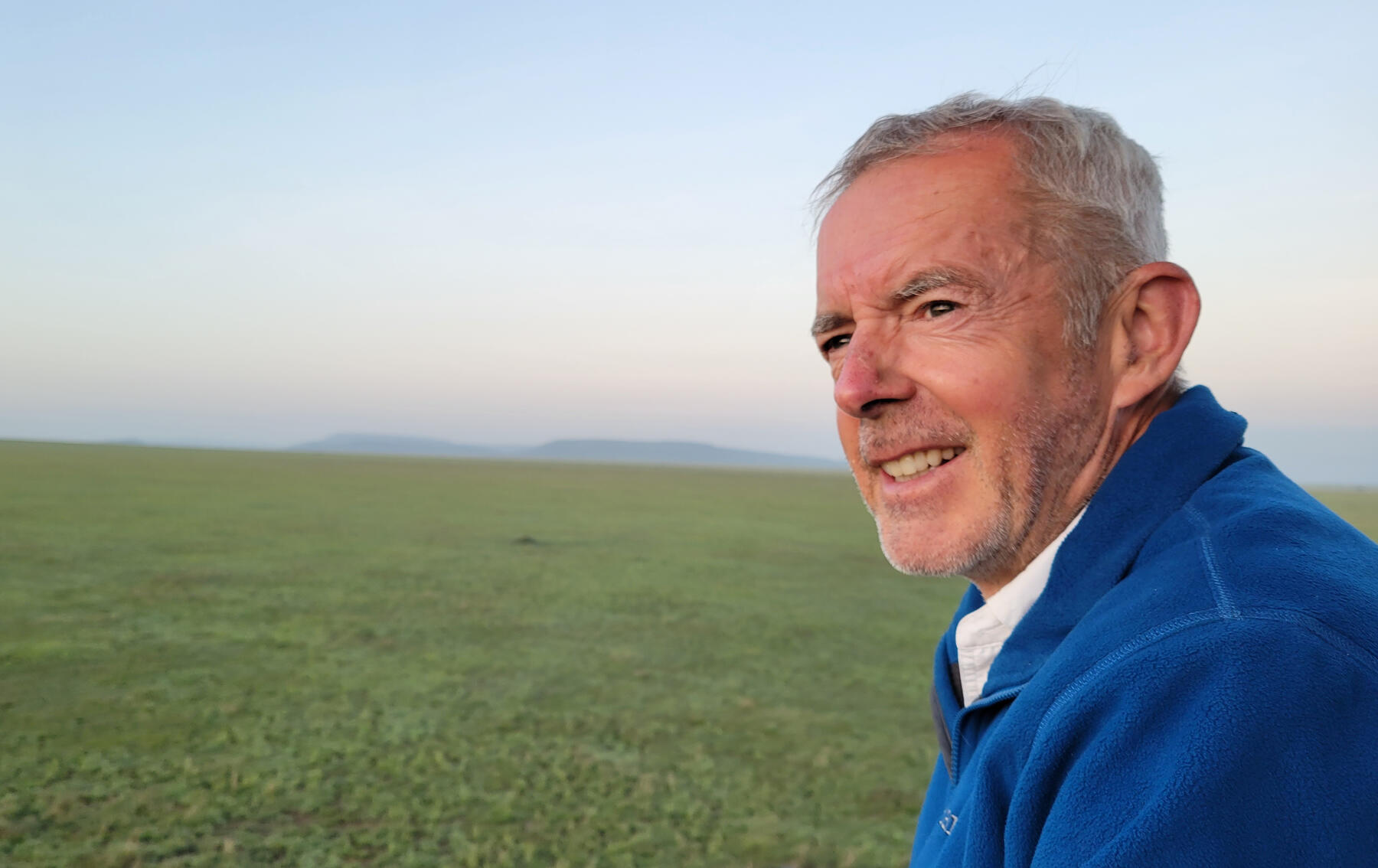
After the close attention demanded by the mountain, the Serengeti opened the view.
What Kilimanjaro Taught Me
Kilimanjaro did not teach me that everyone should climb a nineteen-thousand-foot mountain.
It taught me that many of us are capable of far more than we assume.
We often sell ourselves short before circumstances have asked us to prove anything. We confuse uncertainty with impossibility. We wait for confidence before beginning, when confidence often arrives only after we have begun.
Preparation matters.
Support matters.
Medical judgment matters.
Experience matters.
And asking for help matters.
But absolute control is neither available nor required.
We prepare as honestly as we can. We choose a worthy direction. We begin. When conditions change, we adapt. When the terrain becomes difficult, we accept a hand. When the goal feels distant, we return our attention to the next step.
To summit is a verb. It means to reach a high point, but it can also mean accomplishing something that once seemed beyond us.
The summit does not have to be a mountain.
It might be completing treatment, rebuilding a relationship, beginning to exercise, traveling again, caring for someone you love, writing a book, entering a new season of life, or simply refusing to surrender the day in front of you.
The lesson of Kilimanjaro is not that limits are imaginary.
It is that we should not invent them before we encounter them.
A Question for You
What have you been postponing because you assume the time will be better later?
What might become possible if you prepared carefully, accepted help, and began with the next step?
The Accelerated Life
Go With the Flow
What Egypt taught me about time, wonder, friendship, and living fully with Parkinson’s
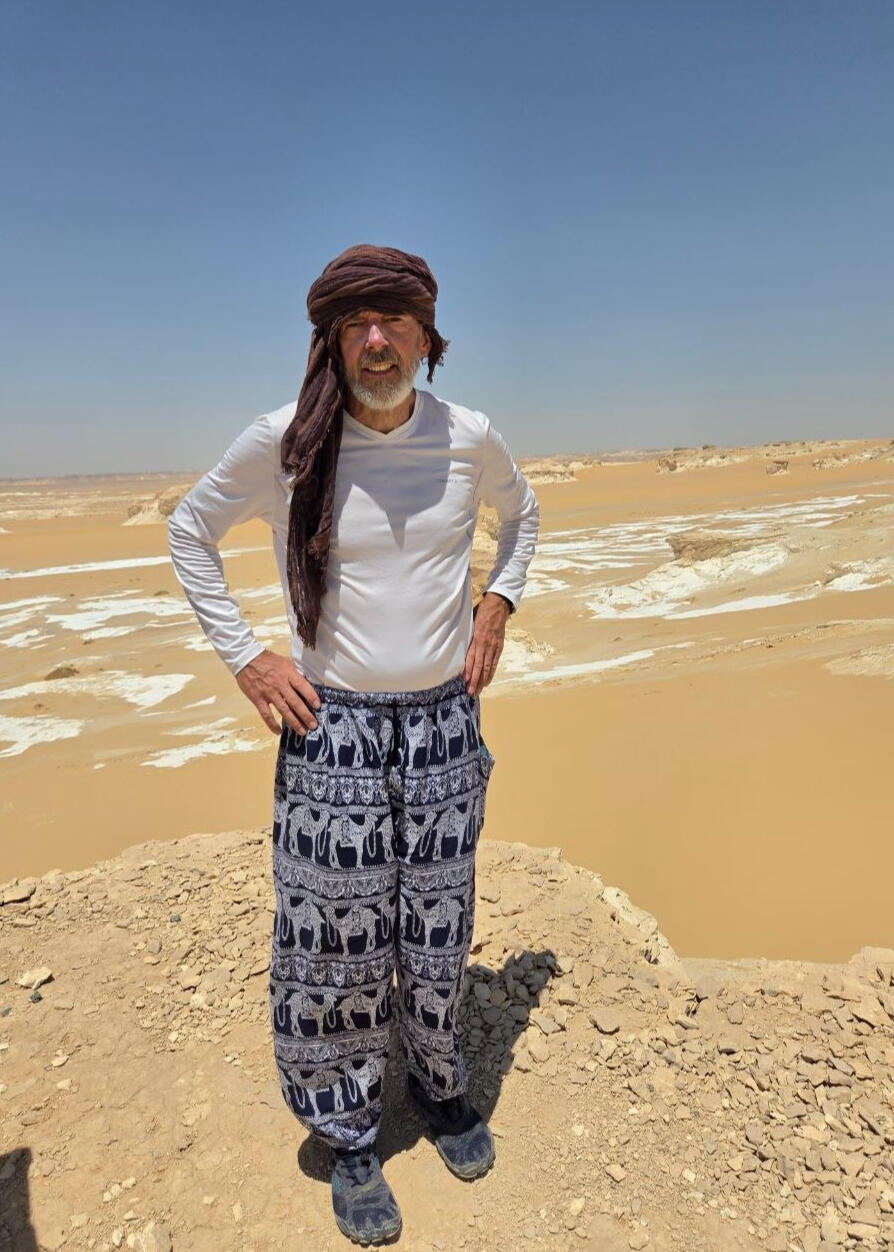
Mike in the White Desert
The idea of Egypt first entered my mind from 25,000 feet.In 2003, while serving in the Air Force, I had the opportunity to fly an F-16 across the Middle East. Our flight path took us over Egypt, and from that altitude the country appeared exactly as a child might draw it: an immense desert, cut by one long ribbon of green along the Nile.Then we flew over the pyramids at Giza.I did not land. I did not touch the desert. I did not walk beside the Nile. But the image stayed with me. Egypt became one of those places stored somewhere deep in memory—not quite a plan, not quite a dream, but a possibility.More than twenty years later, when the invitation came, I needed about twelve seconds to say yes.I was offered a place on a small group trip organized by an acquaintance from Tucson who had led previous journeys to Egypt. Her earlier groups had been all women, and I would be the first man she had invited. The group would be small: five travelers, our organizer, and our Egyptian guide.I did not build many expectations. I wanted to arrive with an open heart and an open mind. I knew there would be pyramids, desert, the Nile, ancient temples, and the Red Sea. I also knew there would be long flights, long drives, heat, sand, unfamiliar food, and uncertainty.But I was not worried about Parkinson’s.That may sound odd. Parkinson’s is part of my life every day. It is present in my body. It shows up in tremor, stiffness, fatigue, and the small inconveniences of movement. But I have learned not to give every symptom emotional authority. A tremor is a tremor. Spilling water from an overfull glass is inconvenient, not catastrophic.There is a difference between having limitations and being defined by them.I was not going to Egypt to prove that I did not have Parkinson’s. I was going because I did.
I was going because life was still available.
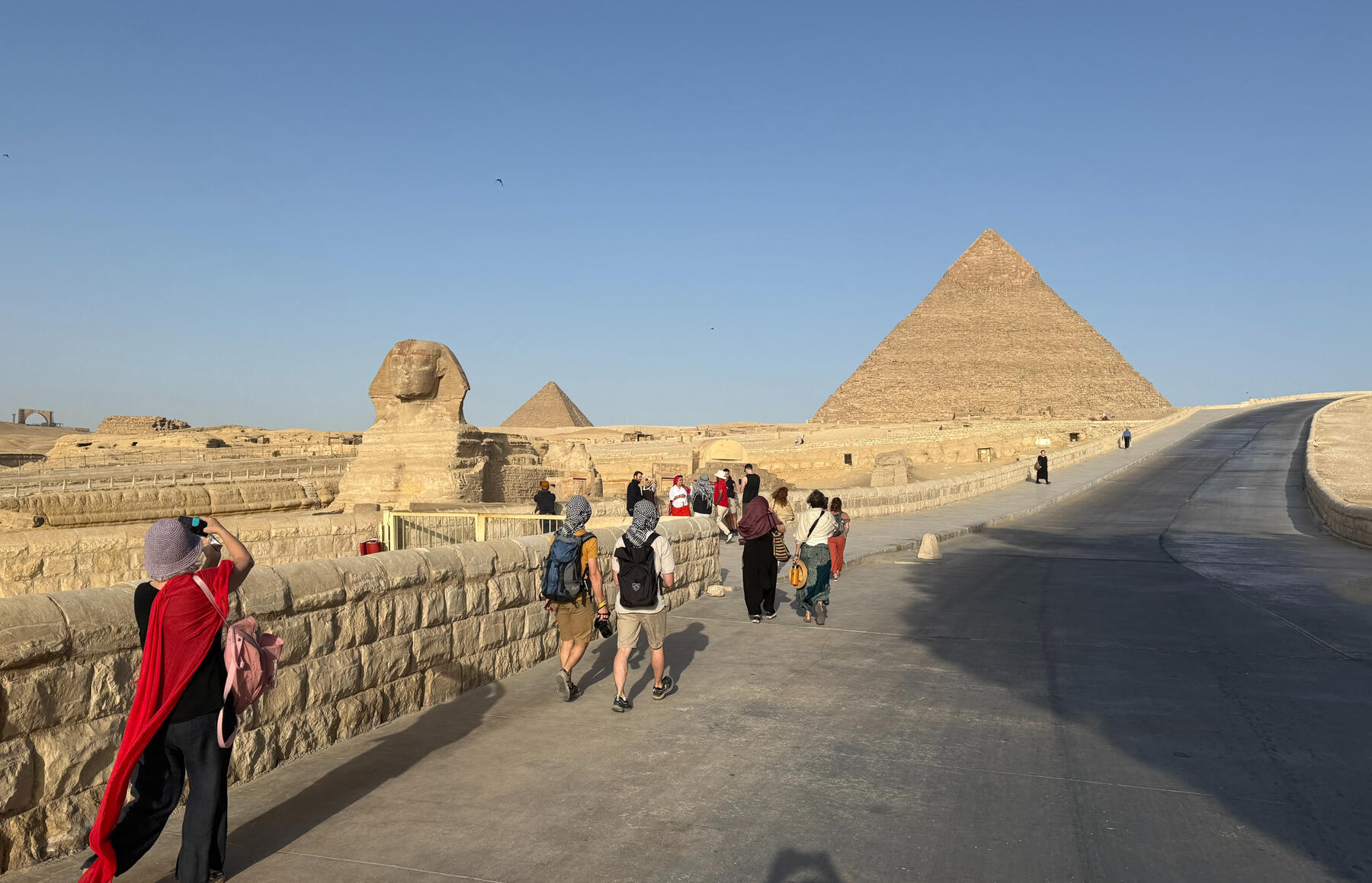
A memory from 25,000 feet became a journey on the ground more than twenty years later.
Cairo
We landed in Cairo around two o’clock in the morning after leaving Tucson two days earlier. The airport felt familiar in the way that large international airports in the Middle East and Africa often feel familiar: late-night lighting, tired travelers, long hallways, people moving in every direction.The drive into the city was quieter than I expected. That was partly because of the hour, but I remember being struck by how beautiful Cairo looked at night. We reached our hotel downtown, across from the old Egyptian Museum, and by the time I got to sleep it was nearly five in the morning.A few hours later I woke to the sound of Cairo.From my seventh-floor balcony I looked out over traffic, pedestrians, buildings, sunlight, and the life of the city beginning below me. I noticed small things immediately. Men walking on the streets. Almost no one wearing shorts. The constant movement. The sense that I had entered a different rhythm.Some of my companions wanted to rest. I did not. I asked what was nearby and whether it was reasonable to walk, then spent about two hours wandering across the Nile and through the area around the hotel.That afternoon we visited the Egyptian Museum, literally across the street.The moment I walked through the doors, I had the feeling: we are not in Kansas anymore.Columns, statues, fragments, carvings, panels, hieroglyphics, stone faces, ancient bodies of work everywhere. My mind went immediately to Indiana Jones, but the feeling went much deeper than movie nostalgia. I was standing in the presence of a civilization I had seen all my life in books and photographs, but which had never been real to my senses until that moment.The next morning, we drove to the Giza Plateau.We arrived early, before the gates opened. Once inside, we began walking uphill toward the Great Pyramid. The pyramids and the Sphinx were visible the whole time, but the true scale did not register until I stood at the base, faced the stone, tilted my head back, and tried to take it in.There are things the mind cannot understand from photographs.A pyramid is one of them.The blocks were massive. The engineering was astonishing. The whole structure seemed too large, too precise, too ancient, and too human all at once.The size of Egypt became real at the base of the Great Pyramid.The age of Egypt became real when we entered and climbed toward the so-called King’s Chamber.
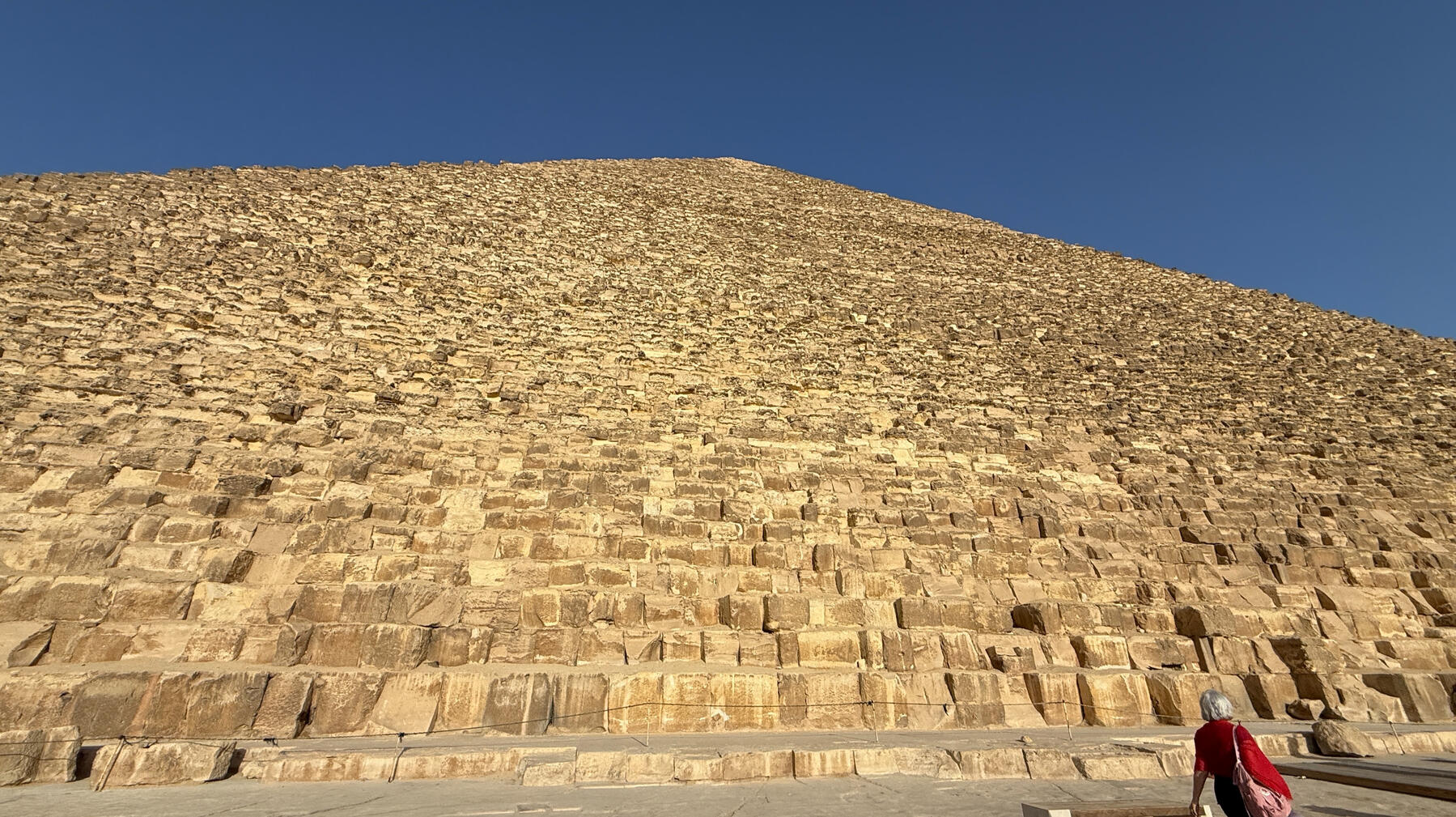
Photographs cannot prepare you for the scale of the Great Pyramid.
The Desert
Leaving Cairo was abrupt.One moment there were buildings, traffic, shops, and noise. The next moment we were heading west into open desert.It felt like crossing a threshold.The Black Desert appeared first, with dark volcanic rocks scattered across the sand and small black hills rising in the distance. It was unlike anything I had seen before. The landscape felt remote almost immediately, even though we were only a few hours from Cairo.The White Desert was different again.White rock formations rose out of the sand, carved by wind and time into shapes that looked dreamlike, playful, and impossible. Some appeared like statues. Some looked like animals. One looked so much like a rabbit that all we could do was laugh.The desert was not only beautiful. It altered time.Our group noticed it almost immediately. Hours seemed to stretch. A single day felt like several days, or weeks, or something outside ordinary measurement. We were a group of experienced meditators, and the desert seemed to intensify that awareness. With few distractions, few structures, and little sense of clock time, the mind opened.The first night we camped in sand beneath a huge rock formation that looked strangely like a figure from one of my own abstract paintings. It had the feeling of another planet—Tatooine, Dantooine, some desert world from Star Wars—but it was also deeply earthly. Sand, rock, sky, fire, stars.The Bedouins cooked part of our meal over a small fire. The food was outstanding. The sunset was unforgettable. The stars were vivid.That was the day I learned to wrap my head with a scarf like a Bedouin.The next morning, sunrise came quietly over the sand. Later, on our way toward the White Desert, we stopped by a solitary fig tree near a steep sand dune. I was surprised by how much shade and life one tree could create. Under that tree, our guides prepared lunch, and we laughed and ate and rested in a place that looked empty until we stopped long enough to see what was there.The silence of the desert was restorative.It taught me something about alone time. Not loneliness. Not isolation. But the kind of spaciousness that allows a person to hear his own thoughts again.
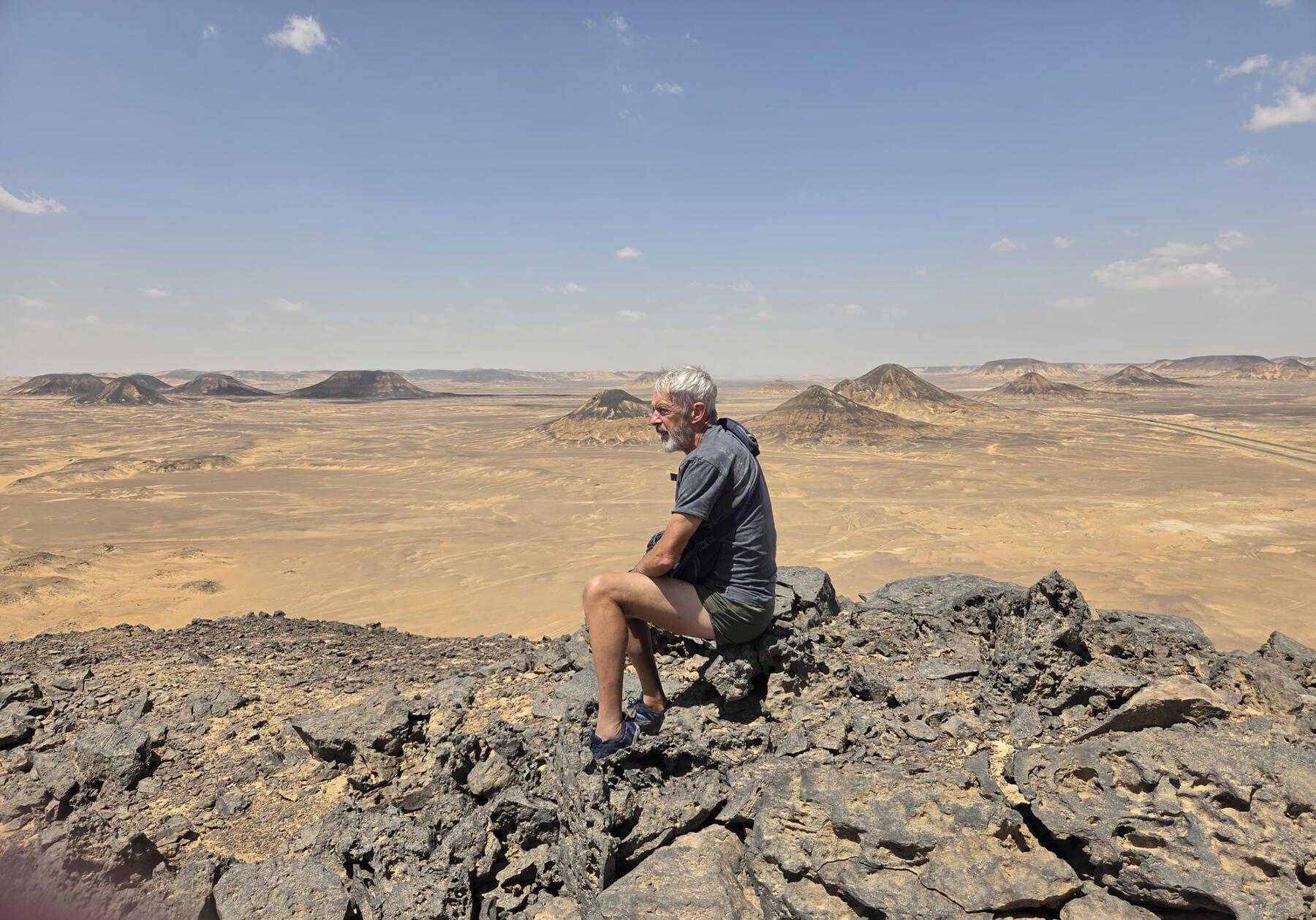
In the desert, time seemed to loosen. Hours felt larger than hours.
Ancient Time
In Luxor, Egypt became not only large and old, but intimate.Karnak was overwhelming in scale. The columns, courts, walls, and ruins were so enormous that it was difficult to understand what I was seeing. Again and again I found myself wondering how human beings, without what we think of as modern technology, could create such massive structures with such precision.The Valley of the Kings affected me differently.There, the human detail stopped me.Inside tombs, the paintings were still vivid after thousands of years. The colors were not theoretical. They were right there in front of us: figures, symbols, animals, gods, gestures, stories. I found myself thinking not only of pharaohs and death, but of the artists.Someone stood here.Someone held a tool.Someone mixed color.Someone made these lines.Someone created work that still speaks after nearly four thousand years.That changed how I thought about legacy.We often use the word “legacy” casually. Egypt makes it concrete. The work of hands, eyes, imagination, devotion, organization, and craft remained visible after more than 37 centuries. I could not help wondering what modern life is creating that will still matter that far into the future.I also began to understand Egyptian religion differently.Before going to Egypt, I had a vague outsider’s reaction to the many gods and goddesses. It seemed strange to me: the god of this, the goddess of that, animal heads, repeated symbols, complex stories.But standing there, surrounded by the carvings and paintings, I began to see something more unified. The stories were not random. They were an attempt to describe relationship: between human life and death, earth and sky, body and spirit, animals and people, river and desert, order and chaos, the visible and the invisible.That felt far less foreign than I expected.In fact, it felt familiar.
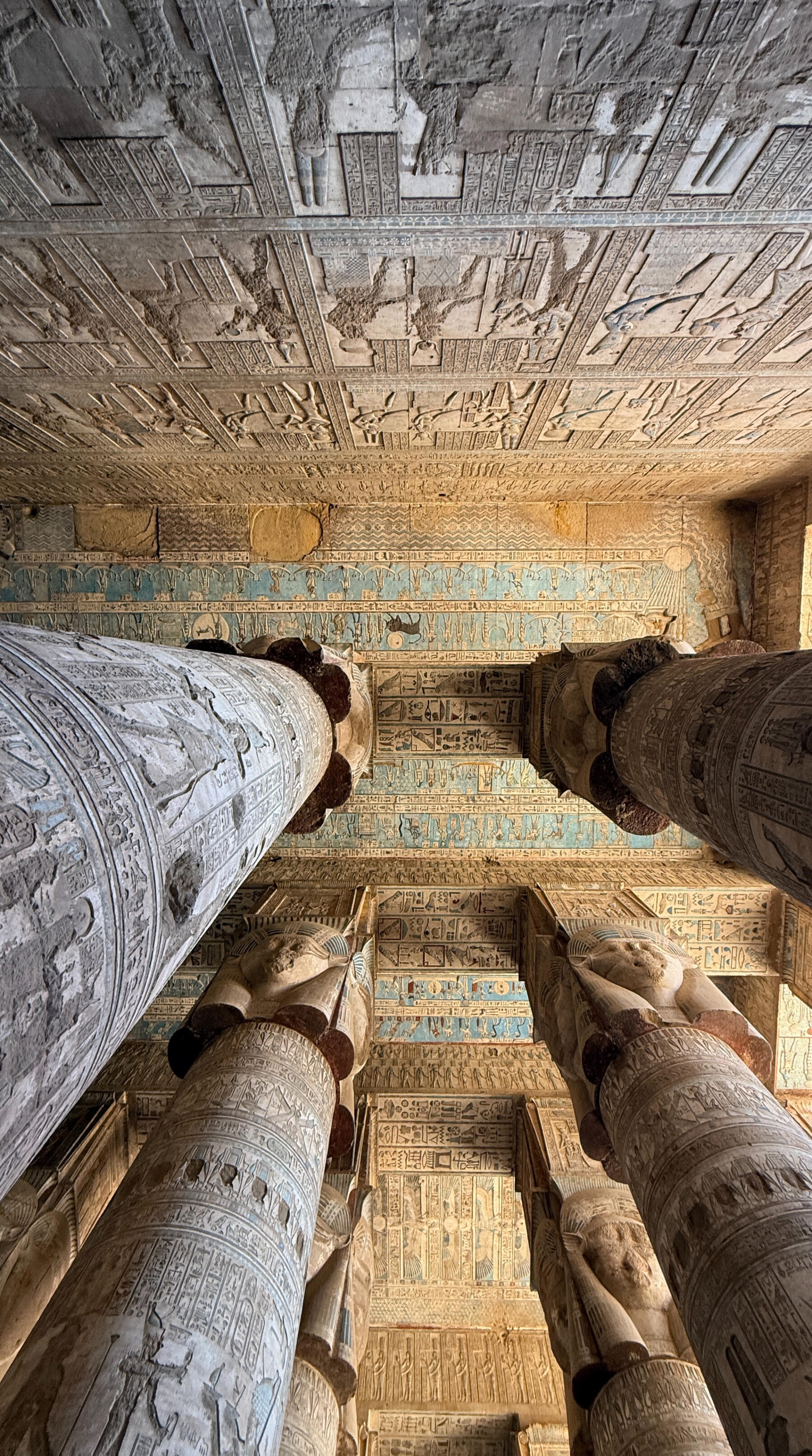
The scale was astonishing, but the human detail was what stopped me
The People
No photograph of a monument can explain the people of Egypt.Our guide, Kawood, became far more than a guide. I was not prepared to like him as much as I did. He was resourceful, funny, kind, capable, and deeply relational. He seemed to know how to get things done without forcing anything. He could solve problems, build trust, translate culture, and make people feel cared for.We also encountered hospitality again and again.On our first night in Cairo, four of us took a cab to a large market. At one point we found ourselves haggling over T-shirts with a vendor. The bargaining was good-natured and lively. We got close to a price but remained about 100 Egyptian pounds apart. Finally the vendor proposed a solution: flip a coin.If I won, I would get my price. If he won, I would pay his.He won.I paid.And I loved it.That small encounter set the tone. Yes, vendors could be persistent. Yes, it could become tiring to step out of a van and immediately be surrounded by people selling small statues or scarves or souvenirs. But beneath that, again and again, I encountered humor, warmth, smiles, and a way of engaging life that felt direct and alive.In Luxor, we stayed on the west bank of the Nile, across from Luxor Temple. The streets were dirt. Children played outside. Small fields were cultivated by hand. Alfalfa was cut and bundled without the mechanization I am used to seeing. Life looked simple, but not empty. People seemed busy, connected, and often content.At one temple in the desert, a young caretaker invited us into his small building and insisted on making tea. He appeared to live with very little, yet he relished the opportunity to welcome visitors.Twice in Luxor, we were guests on local rooftops for meals, music, conversation, and dancing. Yes, we compensated people for their work, but that did not erase the joy. The food was wonderful. The laughter was real. The welcome felt genuine.Egypt was not only stone and sand.It was people.
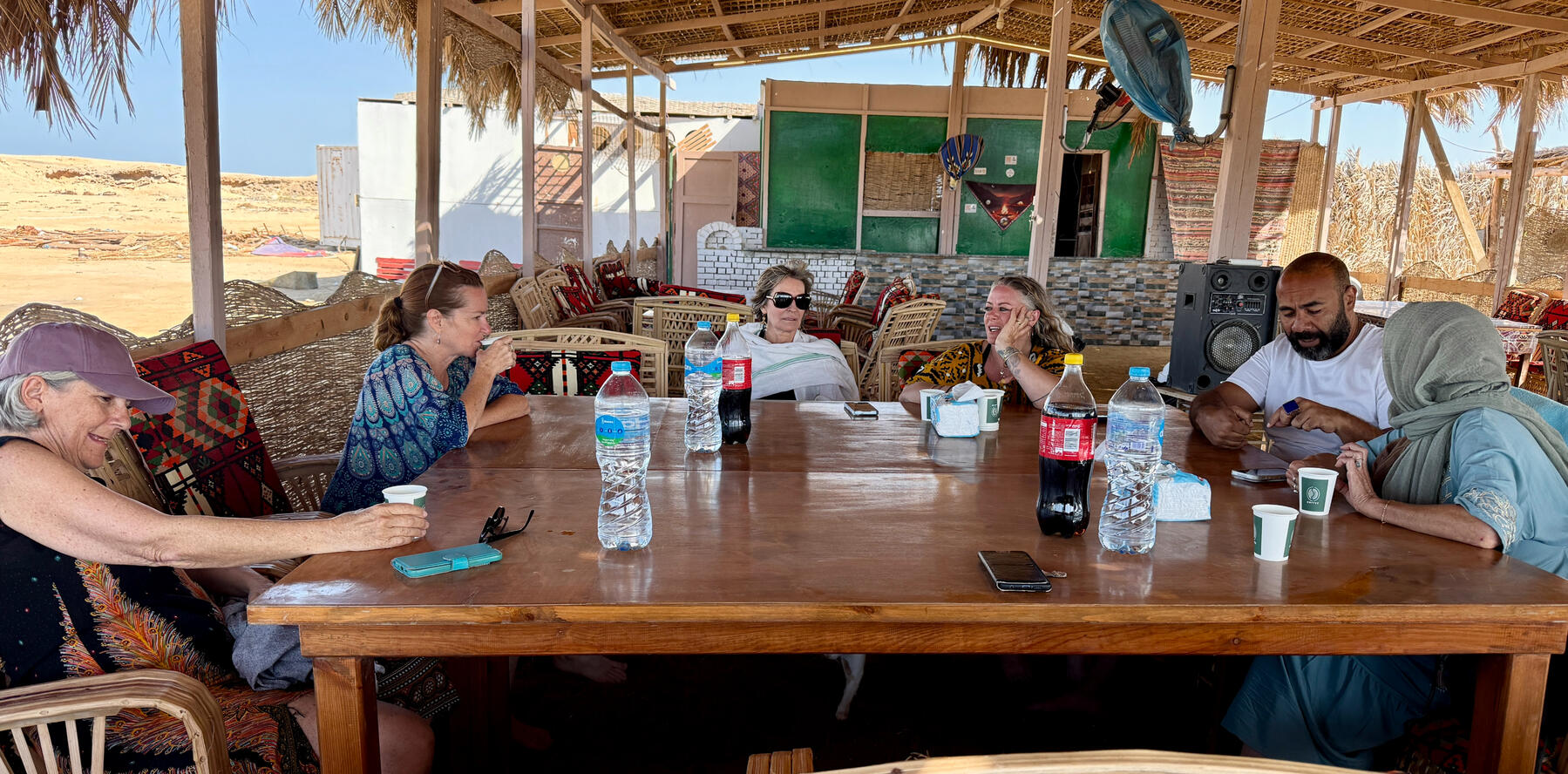
Egypt was not only stone and sand. It was people.
Meditation from the Red Sea
One of the most unexpected moments of the trip happened not in a tomb or temple, but over Zoom.The PWR! annual retreat in Tucson was taking place while I was in Egypt. I had told them I would be traveling and would not be able to participate in person. While I was on my way to Egypt, during a layover, I was asked whether I might still be willing to lead a meditation remotely.I said yes.Why not?The practical question was whether it would work. I did not yet know exactly where we would be, whether the internet would be reliable, or whether the timing would make sense. We eventually found ourselves at Kite City on the Red Sea coast, a windy resort area known for kite surfing. My phone connection was weak, but Kawood had a device on another network, and that solved the problem.The plan was for Becky to speak first at the retreat, and then I would give a short talk about meditation and mindfulness, share a little from my World Parkinson Congress poster, and lead a guided meditation.Then, just before showtime, something went wrong with the presentation technology in Tucson.I heard the room filling. I heard voices. I could tell they were having trouble. Then came the question:“Mike, you wouldn’t mind going first, would you?”Of course not.I was in my room in Egypt, near the Red Sea, dressed in what I called my Egyptian man dress, with a scarf around my neck, looking very much like Obi-Wan Kenobi in the first Star Wars.I spoke about meditation, mindfulness, presence, and Parkinson’s. Then I led a simple beginner meditation focused on breath, body awareness, calming the mind, settling the body, and resting in a moment of peace.The connection held.They heard me.The music worked.And somehow, the distance made the experience more meaningful rather than less.I was sitting near the Red Sea in Egypt, guiding people in Tucson into stillness. The geography was absurd and beautiful. It reminded me that presence is not limited by location.When I returned to Tucson, people at the gym told me they had been there. They thanked me. They said it mattered.That experience strengthened my desire to create guided meditations for this website.
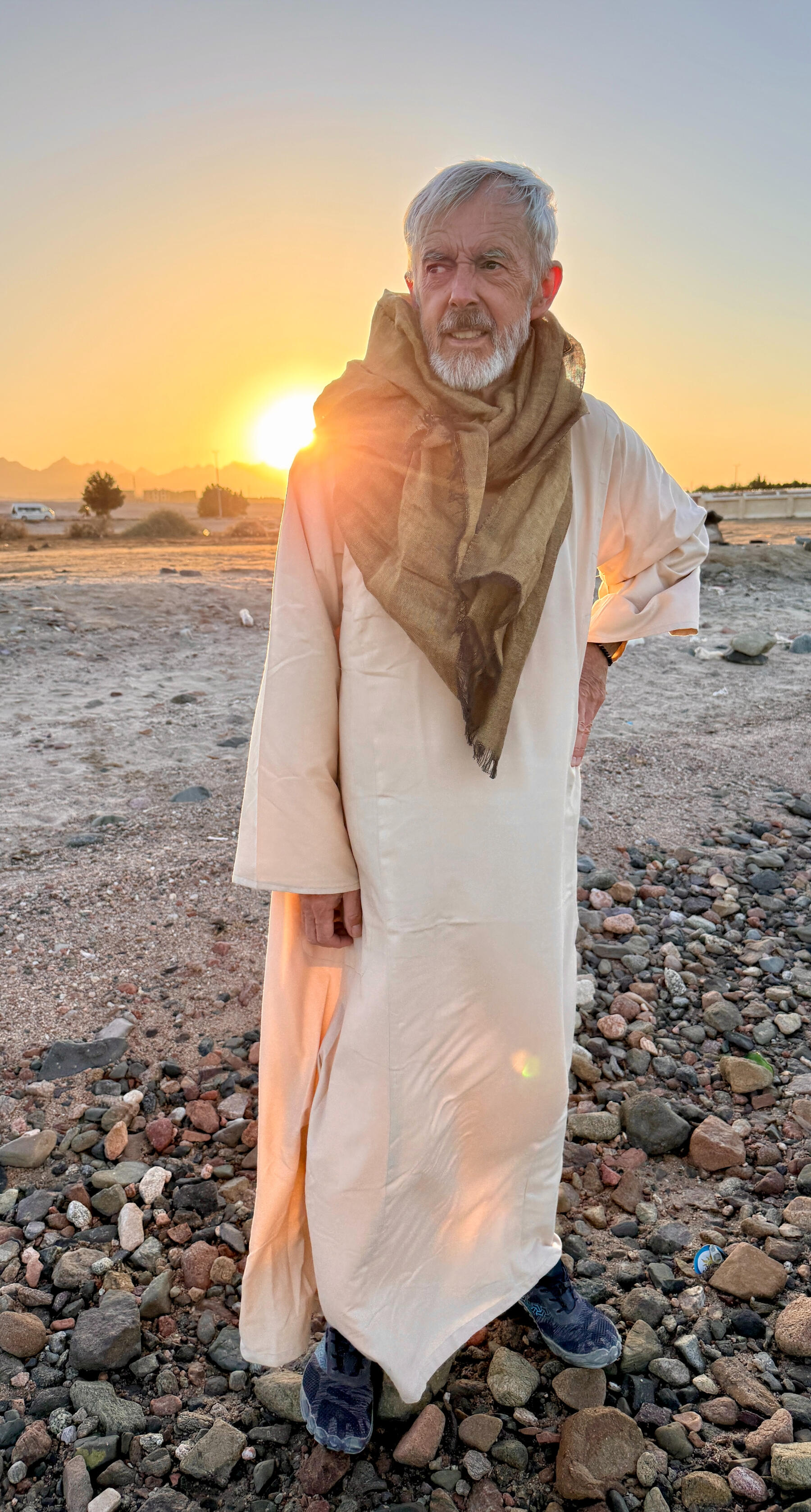
From the Red Sea coast, I led a meditation for a Parkinson’s retreat back in Tucson.
The Red Sea
Hamata and the Red Sea coast felt different from everything that came before.Cairo was intensity. The desert was silence. Luxor was ancient time. The Red Sea was wind, water, rest, and spaciousness.The coast was rocky and sandy. The wind was constant. The water was clear, blue, alive. At a nearby cultural site, we spent an afternoon beside a lagoon, drank tea, ate fish prepared by Red Sea Bedouins, and watched the sunset over mangroves.A few of us swam across the lagoon toward the Red Sea itself, looking at hermit crabs and starfish-like creatures. It was the kind of place I might have rushed past if someone had not taken me there. From the road, it did not announce itself. Once inside, it became a world.Later, on a boat trip to a reef, I found a quiet moment on the upper deck. There were other people on the boat, but no one was near me. I simply sat with the sea, wind, and movement.Peace does not always require silence.Sometimes it only requires space.The most surprising moment of the trip may have been swimming with dolphins. I had not expected to be surrounded by so many of them, so close, so aware of us. It felt playful, intelligent, and alive in a way I had not anticipated.Again and again, Egypt kept changing.Just when I thought I understood the trip, it became something else.
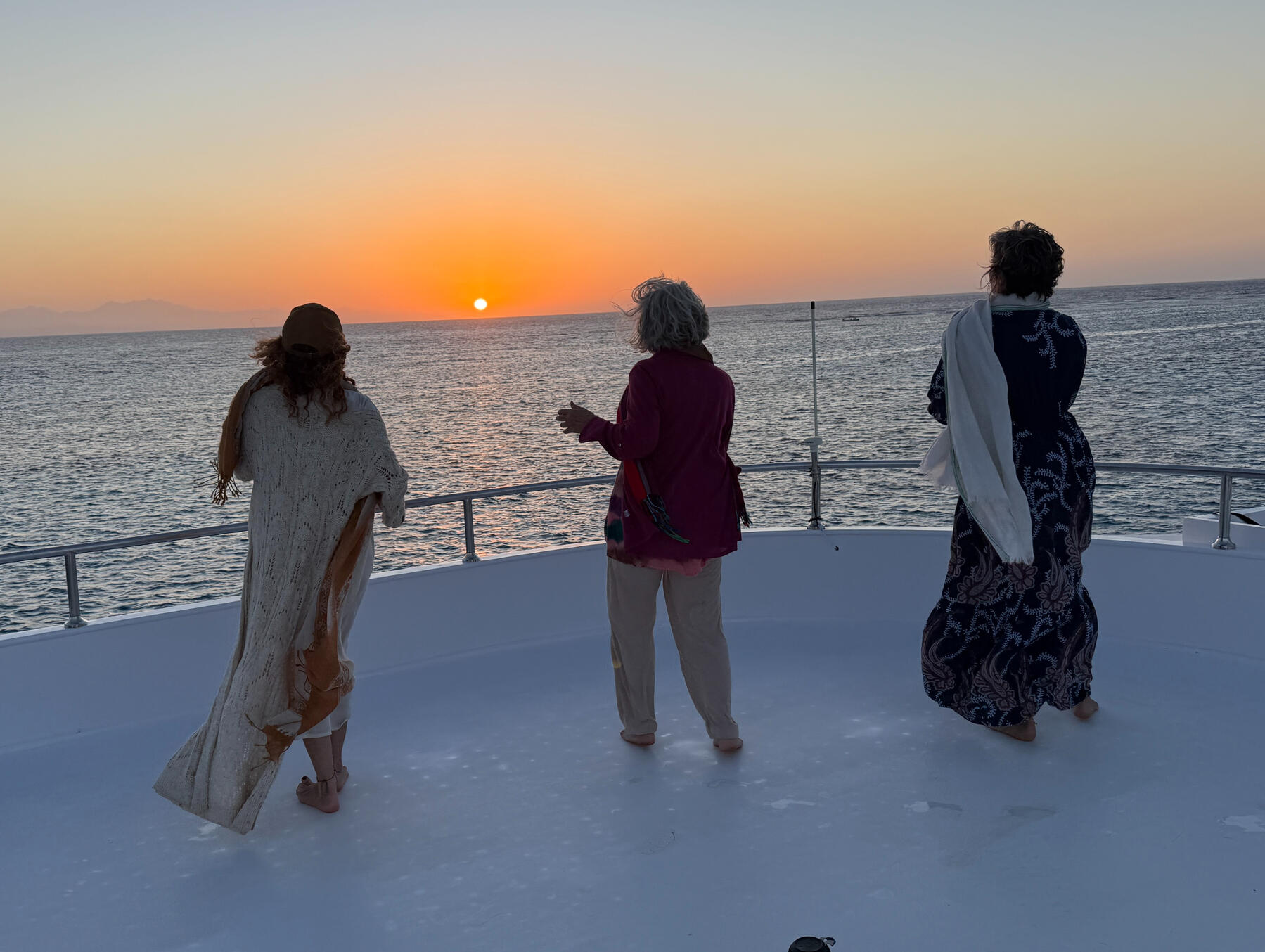
The Red Sea brought wind, water, rest, dolphins, and a different kind of spaciousness.
What Egypt Taught Me
Egypt taught me that time is not as fixed as I often assume.In the desert, seven hours could feel like seven years. In the tombs, human work from thousands of years ago felt immediate. In Cairo, twenty years collapsed between the F-16 overflight that planted the idea and the moment I finally stood beneath the pyramids.Egypt taught me that impermanence and permanence are not opposites.Sand covers things quickly. Wind erases tracks. Bodies age. Civilizations fall. And yet paintings endure. Stone remains. Human effort can echo across centuries.Egypt taught me that wonder is not childish.Wonder may be one of the most mature responses we have. To stand at the base of the Great Pyramid and admit that you cannot comprehend it is not ignorance. It is honesty. To look at the work of ancient artisans and feel humbled is not weakness. It is reverence.Egypt taught me that Parkinson’s does not need to narrow my life.The diagnosis is real. The symptoms are real. The limitations are real. But they do not get to define the whole field of possibility. There is still plenty I can do, plenty I can experience, plenty I can contribute, plenty I can enjoy.And Egypt taught me to loosen my grip.In our culture, we often try to control everything: schedules, outcomes, other people, the future, even our own aging bodies. But so much of life cannot be controlled. It can only be entered.Prepared for, yes.Respected, yes.But controlled? Not really.Egypt reminded me to go with the flow.That does not mean drifting through life without intention. It means preparing carefully, showing up fully, accepting help, laughing often, staying open, and allowing the experience to become what it becomes.You do not have to go to Egypt to learn that.You do not have to climb Kilimanjaro. You do not have to hike across Spain or Portugal. You do not have to do anything dramatic to live an accelerated life.Accelerated living is not about checking off adventures.It is about finding joy every day.It is about asking better questions.Am I enjoying life?Am I doing things that make my heart sing?Am I finding moments of wonder, connection, humor, movement, stillness, and gratitude?Am I waiting for the perfect time, or am I willing to begin now?Egypt began for me as a memory from 25,000 feet.It became sand, stone, water, laughter, friendship, meditation, dolphins, temples, tombs, tea, traffic, wind, and stars.And somewhere in all of that, it became a reminder:Life is still wide open.
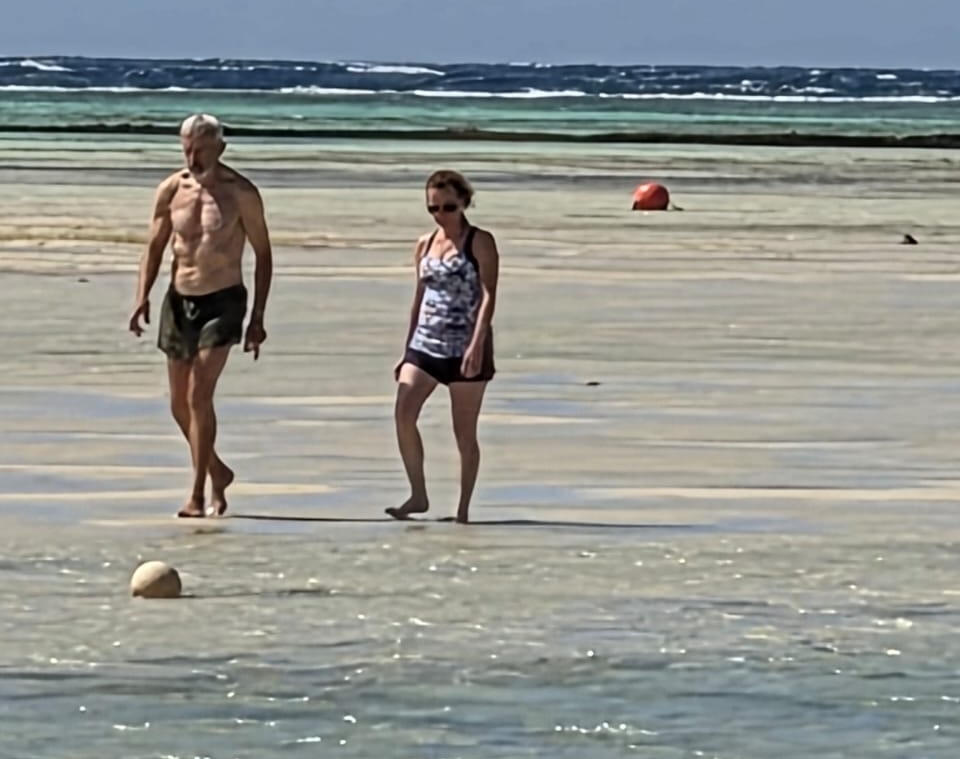
Egypt reminded me to prepare carefully, show up fully, accept help, laugh often, and go with the flow.
A Question for You
Am I enjoying life?
Am I doing things that make my heart sing?
Am I finding moments of wonder, connection, humor, movement, stillness, and gratitude?
Am I waiting for the perfect time, or am I willing to begin now?
A 15-Minute Guided Meditation
A gentle practice for breath, presence, and steadiness
This beginner-friendly guided meditation is offered as a quiet companion for people living with Parkinson’s, care partners, and anyone learning to pause, breathe, and return to the present moment.You do not need previous meditation experience. Sit, lie down, or settle into whatever safe and comfortable position is available to you. Let the practice meet you where you are.
This meditation is for reflection, relaxation, and personal practice. It is not medical advice, and it is not a substitute for professional care. Please practice in a safe, comfortable position.